Sunday, April 29, 2012

Understanding the 1911 Extractor Test

What happens when the 1911 extractor fails

Understanding the 1911 Extractor Test 

by Tim Lau

Recently, there has been a bit of discussion on the 1911 "Extractor Test" and it became clear that many, if not most, don't understand how to interpret the results or how it applies to 1911 function and why the test is not applicable to most modern service pistols. I will attempt to shed some light on this. 

The 1911 Extractor Function Test

First of all, let's describe the test. I first learned heard of this test from my friends Hilton Yam and Larry Vickers. Others, such as Wilson Combat, have shared it online as well. 

The test is simple: fire a prescribed number of rounds through the pistol without a magazine inserted. In the 10-8 1911 Function test, we shoot 16 rounds this way. Eight are fired two handed and eight more are fired strong hand only. 

The empty cases must properly eject between 2 o'clock and 5 o'clock. If any cases go forward, to the left, stovepipe, into your face, or fall through the magazine well, the pistol has failed this test.

Having a magazine in the pistol supports the empty case during extraction and ejection phase of the cycle of operation, which can mask issues such as poor extractor tension or geometry. 

Some folks have said they only fire five to seven rounds this way to evaluate extractor function, but Hilton and I have both found that with higher pressure duty rounds, extractor issues may not exhibit themselves in only seven rounds. If the 1911 can make it through two magazines' worth of ammunition without failing, it is likely good to go. 

Why is this test significant?

This test is designed specifically to test the extractor function in 1911 pistols. Let me repeat: This test is designed specifically to test extractor function in 1911 pistols. It tells you if your extractor is at 100% function or not. If the pistol fails this test, it is not at 100% function. This  is significant for two big reasons:

1. The internal extractor design of the 1911 relies on leaf spring tension, which is highly variable. Depending on the materials used by the manufacturer, and the service cycle of the pistol, the 1911's internal extractor is prone to lose tension and is dependent on a skilled assembler for proper setup. Failing the extractor test indicates that at best, the extractor is only working marginally. Should the extractor have any less tension, the gun will stop working altogether.

2. A marginal extractor has a less than optimal grip on the case rim during extraction, and in a 1911, the case will be pulled into the feed lips of the empty magazine, creating the stoppage in the photo above. The feed lip geometry and concave or flat magazine follower of the 1911 magazine makes the 1911 more prone to this than any other modern service pistol. It is a bear to clear, and destroys your magazine as it will permanently deform your feed lips.


Does the test apply to modern service pistols?

Some shooters have noted that quality modern pistols will not pass this test. This is not as much of an issue as with the traditional 1911 for the following reasons:

1. The coil spring setup of the modern external extractor is not prone to loss of tension like the leaf spring setup of the internal 1911 extractor. Once a pistol is set up from the factory, what you get (in terms of extractor function) on day one is what you will get until something breaks.

2. The feed lip and follower geometry of modern service pistols do not make them prone to having the empty case dragged into the feed lips should the extractor lose grip on the case rim during extraction. 

What about 1911s with external extractors?

This test is the Achilles' Heel of most 1911 external extractor setups. The only external extractor setup that I have tried that will reliably pass this test is the Smith and Wesson E-Series pistol, which uses the wide Performance Center extractor and is optimally positioned in the slide. Many 1911 external extractor designs do not optimally position the extractor relative to the bore axis resulting in marginal extractor function.

While the external extractor setup is not likely to lose tension, the marginal extractor function is still coupled with the geometry of the 1911 feed lips resulting in the malfunction depicted in the photo atop this blog post.

In other words, if you have a 1911 outfitted with an external extractor, and it fails this test, it is NOT good to go. It will be prone to pulling into the feed lips, the empty case of last round fired in the pistol.

Final Thoughts

The "experts" on the Internet have said "oh wow, so this test just proves the gun will only fire one round with no magazine in place. When would I ever shoot the gun in this manner?" Realize that this test was designed from the perspective of evaluating whether or not a 1911 pistol properly setup for service. We are not advocating shooting the gun in this manner as any sort of technique in and of itself.

Every 1911 that comes across Hilton's or my bench is tested for this and doesn't leave the shop unless the extractor is properly set up.

If you are still unclear as to the significance of this test, please carefully re-read this blog post. I hope this sheds some light onto this commonly misunderstood function test.

Special thanks to my good buddy Hilton for his input on this blog post. Please visit the 10-8 Performance Facebook Page and his blog at http://10-8performance.blogspot.com/.

Tim Lau
10-8 Consulting, LLC

Thursday, April 19, 2012

Wilson Tactical Training: Defense Fit

Hilton engages multiple targets with the SIRT Pistol while I begin my weighted box jumps/steps in this DefenseFit session.


Too many times I have either attended or taught firearms courses with students, wishing to learn how to survive a deadly force encounter, who would be better served walking around the block. Don't get me wrong, anyone serious about personal safety should have a baseline level of firearms knowledge and I applaud anyone willing to spend their own money and take the time to better themselves by attending a firearms class. However, there are many folks who wrap themselves around the axle about caliber selection or the best way to put down multiple armed attackers when the reality is, given their physical condition, they are far more likely to die of a heart attack or slip into a diabetic coma than find themselves in the middle of a home invasion robbery.

Good physical fitness is as important as skill at arms, and greatly improves quality of life. In addition, it significantly contributes to our ability prevail should we find ourselves in a life or death struggle, and it increases our survivability should we become injured in such an encounter. Unfortunately, it seems many firearms enthusiasts and students completely ignore this area of training.

Last month, my good friend Hilton Yam and I were teaching a 10-8 Duty 1911 Course in the greater Seattle area, and had the opportunity to train with Jeremy Wilson of Wilson Tactical Training. When he offered to put us through a sample of his DefenseFit program, we seized the opportunity. Wilson Tactical Training's DefenseFit program incorporates functional strength and cardiovascular training with defensive tactics and shooting skill development. The idea is not only to get a great workout, but to produce physical stress to simulate what one would feel in a self defense or lethal force encounter.

Hilton and I arrived at one of the training facilities Jeremy Wilson uses to teach his courses on Sunday morning and met Jeremy for the first time. Jeremy is a full time police officer with over 13 years of experience, serving as a SWAT operator, use of force instructor, firearms instructor, and holds numerous instructor and armorer certifications. He is also a longtime student of the martial arts. He explained what we would be doing and told us he would give us a sampler plate of what his courses have to offer.

We put on our concealed carry rigs, which consisted of a CompTac belt holster and magazine pouches underneath a concealment garment. We would be using Next Level Training's SIRT Pistol. SIRT stands for Shot Indicating Resetting Trigger. The SIRT pistol is an inert training pistol that features a self-resetting trigger and a laser indicator. The external shape and dimensions resemble a Glock 17. It uses weighted, inert training magazines that fit in G17 magazine pouches (as well as the actual Glock 17). This training aid allows the student to safely perform exercises and force on force drills, yet the laser indicator keeps the training realistic. Misses are called as misses by the instructor, which usually means the student is doing pushups!

Hilton and I started with a five minute warmup on the rowing machines, then progressed to the medicine ball exercises. Agility and weighted box jump drills integrated with multiple shot engagements were next. We continued with clinch drills, firearm retention drills, sprints, shooting on the move, and marksmanship/gunhandling drills integrated between the exercises. Ground defense drills, positional shooting on the VTAC 9-hole wall, and air squats rounded out our session, which lasted over thirty minutes with only very short water breaks in between.

The training highlighted the difficulty of making technical shots requiring fine trigger control and forced me to focus on fundamentals, while battling fatigue and coping with an elevated heart rate. It reminded me of what instructors used to do to us in the police academy: using physical exhaustion to simulate stress. It worked then, and it still works now. 

If you have not integrated your workout program with defensive marksmanship skills, you are missing out on a highly effective training method. Use your imagination and try it. And if you are anywhere near the Pacific Northwest, seek out Wilson Tactical Training and check out their DefenseFIT program. It will open your eyes and just might save your life.


NextLevel Training's SIRT Pistol is an integral part of the DefenseFit program.


Source:


Wilson Tactical Training

Saturday, April 14, 2012

Bullseye Shooting and the Importance of Basic Marksmanship

My target after the 25-yard portion of the FBI Bullseye Course
With the proliferation of "tactical" training, I have noticed that one area that many shooters tend to neglect is basic marksmanship. Sure, it is a lot of fun to practice hosing a target at five yards, but it really doesn't do anyone any good if the rounds are not on target.

It isn't nearly as exciting to shoot slow fire groups at 20 or 25 yards, but I have learned this skill separates the "men from the boys" especially in the police firearms training world.

One of my favorite courses of fire to evaluate Basic Marksmanship skills is the FBI Bullseye Course. It is not fancy, but it is a great evaluation of the shooter's understanding and application of sight alignment and trigger control.

The course is simple and is scored on an FBI Bullseye target (similar in dimensions to an NRA 25 yard rapid fire pistol target). All stages begin with pistol aimed in, safety off, finger on the trigger. This is not a tactical course but rather one that evaluates a specific skill set.

The course is as follows. All shots are standing, freestyle.

25-yards, 10 rounds, 4 minutes.

15-yards, 5 rounds, 15 seconds. Do this twice.

15-yards, 5 rounds, 10 seconds. Do this twice.

Total possible score, 300 pts. Passing for instructors is 270.

Download and print the 10-8 Bullseye Target which has the same scoring dimensions as the FBI Bullseye and try it out!  If I remember correctly, my best score ever on this course of fire was in the mid 290's. Let us know how you like it and what your score is!

Thursday, April 12, 2012

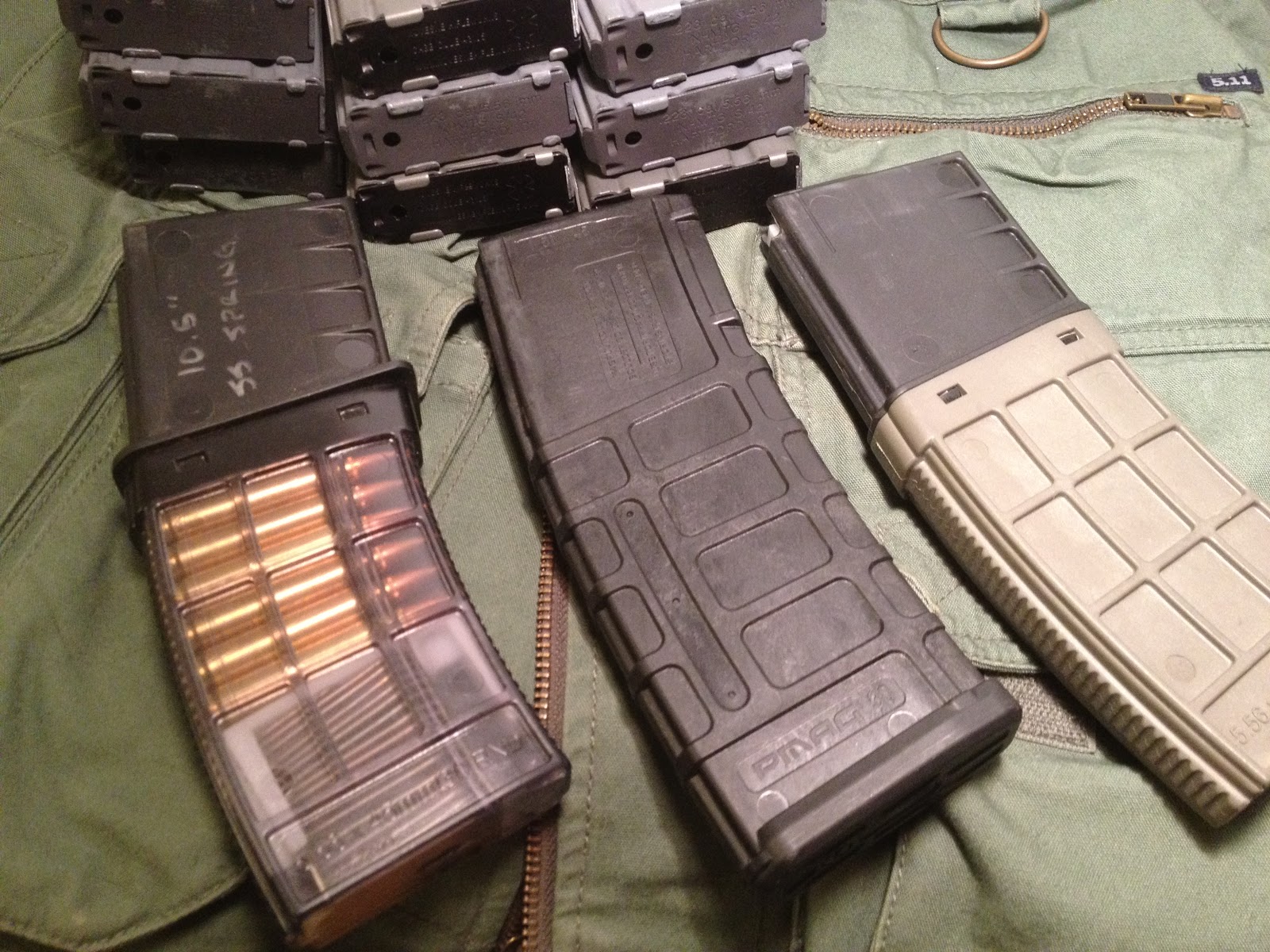
Our Take On AR-15/M16 Magazines

L to R: Clear TangoDown Mag, MagPul P-Mag, and Standard TangoDown Mag
It does not seem long ago, that dark decade in which "large capacity" magazines could not be sold to anyone unless they were a law enforcement officer with a letter from the head of their police agency. "Grandfathered" magazines went for three or four times their original price, and those who had them, hoarded them.

Fast forward to the present, and magazine prices are back down and there are more choices in M16 magazines than ever before. The latest craze is the utilization of high tech plastics that are lighter and stronger than ever before. Going the other direction, some manufacturers have gone to steel.

Some popular magazines include the MagPul Magazine, TangoDown ARC Mag, Troy Battlemag, Lancer L5 magazine, C-Products' steel magazine, and the HK 416 magazine. With all these choices in magazines, it is tough to choose what is best. Unfortunately, there isn't a 100% answer.

Here is a non-comprehensive review of some of the mags we have had some experience with. This is not meant to be an all encompassing review of every magazine on the market, but rather, my general approach to choosing a magazine suitable for my mission, which is primarily range/training use, LE duty use, and self defense.

Prototype Translucent TangoDown ARC Mag and MagPul MagLevel


TangoDown ARC Mag
Our friends at TangoDown have an innovative polymer M16 magazine called the ARC magazine. It is designed to survive drops, while fully loaded, onto its feed lips, and hold up to the hard knocks of LE duty and military use. I have found the magazine to be quite durable and repeated drops, even when fully loaded, onto concrete have no ill effects on reliability.

A common complaint is that it can't be taken down for cleaning. The reality is this is a non-issue as a quick rinse or a couple passes with a KleenBore magazine brush and it is good to go. Some question the integrity of a two-piece design, but I have yet to see one come apart. The halves are unitized with a high strength bonding agent and also feature a physical backup system of four tabs.

The only issue I see is that the follower hump is on the left side, which differs from the blue million legacy USGI magazine on the market and in circulation. Yes, this can be chalked up to a training issue, but the reality is that most people (cops, especially) are mentally lazy and there is a likelihood of cramming 31 rounds in the magazine, stopping the show altogether. Yes, the new Army "tan" follower is also on the "wrong" side, but there really aren't many of those on the market to make a difference.

Some early versions of the ARC magazine exhibited feeding problems in some guns, but my experience with the latest production magazines tell me they are excellent.


MagPul P-Mag
These guys started it all. Before them, the only polymer magazines on the market were made by Thermold and Orlite, neither of which were very reliable or durable. The P-mag set the new standard for reliability in polymer M16 magazines. They are designed with an extremely stable follower, robust spring, and a polymer body that is tough as nails. It can be loaded to thirty rounds yet can still be seated in a magazine with the bolt forward.

I like these magazines a lot and would not hesitate to put them to use at work or home. They are available with or without a window on the side that allows the shooter to quickly gauge the number of rounds left in the magazine. Really brilliant.


HK High Reliability 416 Magazine
I have had quite a bit of experience with this magazine. It is made of steel, has a stainless anti-tilt follower, is slightly longer, and coated with HK's black, corrosion resistant finish. The latest generation has a black follower and a rubber insert to keep the base pad in place.

This magazine works great when new. Unfortunately, over time, the springs take a set and fail to provide enough lift on the follower to lock the bolt to the rear when the magazine is empty. I have seen this contribute to feeding malfunctions. Drop the magazine on its feed lips even when partially loaded, will result in their bending, rendering the magazine useful only as an interesting paper weight.

So What to Buy?
There are a gaggle of other magazines on the market, made of plastic, aluminum or stainless steel. Some work great, others, not so much. What will you find in my range bag? I have found it hard to get away from the GI magazine. From various dealers, such as 44mag.com or Bravo Company USA, they are available for about $10 a piece. In my experience, they work great when new and they stay working for a long time. When they stop working, I toss them and buy new ones. As Pat Rogers likes to say, if you ever come across a used M16 magazine at a gun show with my name scribbled on it, don't buy it!

Don't fall in love with your magazines. At $10 a piece, GI magazines are cheaper than nearly every other magazine on the market and are easily replaced. Which brand to buy? I have had great experiences with Colt marked magazines, NHMTG magazines, and D&H magazines. For what I use them for, I have not found much of a functional difference between the teflon and the dry film coated versions.

Do you have a favorite magazine? Tell us in the comments!

Tim Lau
10-8 Consulting, LLC

Sources:


TangoDown LLC

Magpul Industries

44mag.com

Bravo Company USA


Monday, April 9, 2012

Tool of the Trade: The Shot Timer

Various shot timers I have used over the years

It never ceases to amaze me when I meet a firearms instructor or self professed serious shooter who does not own a shot timer. Some have never even heard of one, let alone actually have one in their range kit. So first things first, what is a shot timer? An electronic shot timer is a device that gives off a start signal (usually a loud beep) and then listens for shots and records the time. Devices range from super fancy (like the PACT MK IV, that has more computing power than the mainframe that launched the first space shuttle) to simple like the PACT Club Timer III. There are even apps for the iPhone that will do the same thing.

Why a shot timer? As shooters, we are always trying to pursue that elusive balance: the perfect combination of speed and accuracy. Well, accuracy we can measure. We can look at holes in a paper target or listen for that satisfying ding on that steel plate.  Without a shot timer, we will never know what we are capable of in terms of speed. Feeling fast and actually being fast are two very different things. If you watch a top level competitor draw and fire, it does not look all that fast. But the timer doesn't lie. The reason for this is because that USPSA Grand Master is not fast because of sheer hand velocity, but rather, he has found the most efficient path in which to move. It is economy of motion. And there is no way to accurately measure this without a shot timer.

Without a shot timer, there is also no way to measure progress. With only a paper target to measure my ability, I can't tell if I am making any gains in terms of speed. I don't know if my first round hits out of the holster are in 2.0 seconds or 1.5. With the shot timer, I am able to measure my ability. I can map out my theoretical times based on my ability to perform certain tasks. For example, if I know that my first round hit out of a holster takes me 1.1 seconds, and my split times are .20 seconds, I should be able to complete a Bill Drill (six rounds from the holster on an 8-inch plate at 7-yards) in 2.1 seconds or so. Sun Tzu famously wrote, "If you know your enemy and know yourself, you need not fear the result of a hundred battles." The timer gives me the ability to know myself, to know what I am capable of and what I am not.

With all that in mind, it is also important not to get too wrapped around the axle about times. The timer is simply a way to measure mechanical skill, but speed should not replace accuracy or proper tactics. Don't get so wrapped up in shaving every tenth of a second off your times if it means you are giving up safety, tactical advantage, or consistency. Just because a technique is faster does not necessarily mean it is better for fighting; however, it is still important to have and use a timer to evaluate proficiency and efficiency when performing a particular task, such as an emergency reload or transitioning between targets.

Lastly, that shot timer adds stress. Anyone who has had shot on the timer knows the stress of being under the clock. This is a good way to add stress to your training and to evaluate your performance under that stress.

Which timer to get? A simple timer is the PACT Club Timer III. It features big, easy to activate buttons. Par times (times that you strive to meet, and are indicated by a second beep,) are easily set and the big LED display is easy to read. It is a good choice. I had previously been using the discontinued CED 6000, but it is getting a bit long in the tooth and some of the LCD elements have gone dead. For a do-everything timer, the PACT MK IV Championship Timer is the Cadillac of them all. It does everything including measure rate of fire, save strings of results, and can act as a chronograph if you have the screens to hook up to it. The only downside is that the MK IV will drain the battery even when dormant, so you will need to remember to take the battery out between range sessions.

At the suggestion of my good friend Hilton, I am also using the new CED 7000. It does everything my old 6000 did but in a smaller, more portable package. It has an internal rechargeable battery which I am not sure I like since that means I have to take it out of my range bag and plug it into the wall rather than just shove new batteries in it. The buttons are small and look somewhat cheap but the display is big enough to read and the small size and light weight are a plus. The timer does not come with a belt clip, which must be purchased for an additional $15 or so. That is a fail in my book, but I bit the bullet and it seems to be working okay.

If you have an iPhone, SureFire has a free shot timer app that works in a pinch. While it will not replace a dedicated shot timer, it will work in a pinch. I use the par timer function on it for dry practice training with my SIRT pistol. The volume can be adjusted in the app for indoor dry practice in my living room and won't blow out everyone's ear drums. It is in the App Store so check it out.

If you are truly a student of the gun, make sure you have a shot timer in your range bag and USE it.

Resources:

Competitive Edge Dynamics (CED)

PACT Timers

Sunday, April 8, 2012

Compensators: Range Toy or Legitimate Tool?

A well-used BattleComp 2.0

Back in August 2011, I was introduced to the guys over at BattleComp while at a shooting course. The thing that immediately stood out about them is that they are shooters. Not only do they have many decades of law enforcement experience, but they love to shoot and train. And they are good at it. I couldn't (and didn't) pass up the opportunity to try a couple of their products.

Now before I go any further, I have always been skeptical about using compensators for anything other than gun games or range toys. I have tried half a dozen different types and shot next to many more compensators and all have shaken my fillings loose to one degree or another. Recently, I was zeroing an optic next to a shooter with a rifle equipped with a SureFire MB556K and it was like being punched in the face every time he pulled the trigger. 

Compensators reduce muzzle climb to varying degrees, but experience has told me that they also act as flash, noise and concussion enhancers. So despite really liking the BattleComp guys, I didn't have high expectations; my bad experience with all other compensators for the AR/M4 platform had left me underwhelmed at best. I expected the BattleComp to tame muzzle rise a bit, but also enhance the flash and produce unacceptable concussion to the sides. In a single man competition, this may be annoying to bystanders. In a tactical entry or team environment, the enhanced blast could render your partner unable to fight.


So it was with more than a little skepticism that I attached a BattleComp 2.0 to my rifle. After several trips to a couple different ranges, both indoors and out, I am impressed. As a compensator, the BatteComp does its job in spades. The muzzle does not climb at all. It simply needs to be shot to be believed. I put a BattleComp equipped rifle in my buddy Dean Caputo's hands. I captured his spontaneous reaction on the video below. 

As for measurable increase in performance, if the shooter has reasonable control of the rifle through stance and grip (and good trigger control) the BattleComp will allow the average trained shooter to keep rounds on an 8-inch target at 7 yards as fast as he can manipulate the trigger. 

This performance does come at some cost. Flash is slightly more than an A2, but not objectionably so. Concussion is also somewhat increased, but it is not terrible. At Pat McNamara's recent class here in Southern California, Centurion Arms' Monty LeClair stood right next to my BattleComp and asked me to light off a few rounds. In the name of science, I was more than happy to do so. He reported it was definitely an increase over an A2, but it wasn't bad at all.

If you get the chance, absolutely try one out and see if the reduced muzzle climb is worth the mild increase in flash and concussion. If you're anything like me, I think you'll be making a phone call to the boys over at BattleComp.

Here are a couple videos to illustrate the point. Have you tried a BattleComp? Let us know in the comments!


Glock 17 vs. M&P 9?

Glock 17 RTF vs. S&W M&P 9

A couple days ago, the Vuurwapenblog responded to GunNuts Media blogger Shelley Sargent's question: Why the M&P?. Shelley eloquently highlights some of the advantages of the M&P over the Glock, including truly ambidextrous controls, interchangeable backstraps to accommodate different sized hands, and location of manufacture.

I own both, and having put many rounds through multiple copies of both models (and with all due respect to Shelley, whom we at 10-8 hold in high regard,) I have to side with the Vuurwapen blogger on this one, mainly due to the accuracy issues of the M&P 9mm. With nearly any box stock Glock 17, I can hold better than three inches at 25 yards using factory ammunition. With most M&Ps, my groups at the same distance using the same ammunition is around eight inches.

To add insult to injury, most M&Ps come with nearly unusably bad triggers out of the box. The end user must either send the pistol back to the S&W Performance Center for a sear upgrade, or purchase the excellent Apex Tactical Hard Sear to have a pistol with a decent trigger. Glocks consistently come with workable triggers right out of the box.

That said, the M&P in 45 caliber is extremely accurate and if mated with a Performance Center (or better yet, an Apex Tactical sear), the trigger is good to excellent. Make a M&P 9mm with a Performance Center Sear with the accuracy of an M&P 45 and I will be sold. Until then, the Glock 17 wins this battle of the fantastic plastic nine millimeters.

Visit the Gun Nuts Media Blog and Vuurwapen Blog and tell us what you think!

Tim Lau
10-8 Consulting, LLC